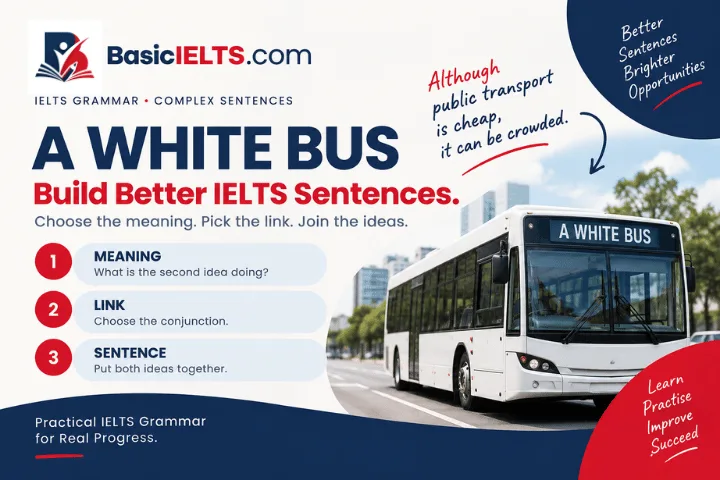
Using complex sentences in IELTS can help you express your ideas more clearly in both Writing and Speaking. However, a complex sentence does not mean a long or confusing sentence. The key is to connect two ideas correctly and show the relationship between them.
A simple way to build a complex sentence is:
Meaning → Link → Sentence
First, understand the relationship between your ideas. Then choose the appropriate linking word.
For example:
Although public transport is cheap, it can be crowded.
Here, the two ideas show contrast, so although is the correct link.
Useful Conjunctions for IELTS
Different relationships require different conjunctions:
- Reason: because, since, as
- Contrast: although, though, even though, whereas
- Condition: if, unless, in case
- Time: when, before, after, until, while
- Purpose: so that
For example:
Because housing costs are high, many students work part-time.
If governments improve public transport, traffic congestion may decrease.
Schools teach digital skills so that students can use technology safely.
These structures are useful in IELTS Writing Task 1, Writing Task 2, and Speaking. In Task 1, conjunctions such as while and whereas are particularly useful for comparing information. In Task 2, because, although, and if can help you explain reasons, contrasts, and conditions.
Avoid Common Mistakes
Be careful not to use two connectors for the same relationship.
❌ Although it is cheap, but it is crowded.
✅ Although it is cheap, it is crowded.
Also avoid using will after if when talking about a future condition:
❌ If the government will invest, traffic will fall.
✅ If the government invests, traffic will fall.
Remember that unless already means “if not”, so avoid adding another negative.
Most importantly, don't use complex sentences just to appear advanced. A short, accurate sentence is much better than a long sentence full of mistakes.
Follow given PDF to correctly use Complex Sentences in IELTS Test and get higher band score.